Cybersecurity training for Texas colleges and universities
Research data, student records, and financial aid systems make campuses a prime target. Give faculty, staff, and student workers a focused one-hour course, then track every college and division from one admin portal.
- TXCC-certified, FY 2026-2027
- About 60 minutes
- QR-verified certificates
- One-click compliance report
What Texas law asks of higher education
Public universities and community college districts fall under the annual cybersecurity training requirement that began with House Bill 3834. The requirement now sits in Texas Government Code Chapter 2063, administered by the Texas Cyber Command (TXCC).
Who must train
Employees who use a computer for at least 25% of their duties, which includes most faculty and staff, plus elected or appointed officials such as regents and community college trustees.
A certified program
Training must be a state-certified program. This course is TXCC-certified for fiscal year 2026-2027 under Section 2063.102.
Every fiscal year
Completion is tracked by the state fiscal year, September 1 through August 31, so plan training into the fall semester.
Foreign adversary rules
Section 572.070 limits gifts and travel from foreign adversary sources and requires reporting within 30 days, which matters for international research and conference travel. Module 4 covers it.
This page summarizes common obligations under Texas Government Code Chapter 2063 and Section 572.070. Confirm the requirements for specific positions with your legal counsel.
Everyone across campus
Faculty
Instructors and researchers, including adjuncts, with a course that fits between classes.
Administrative staff
Registrar, admissions, financial aid, and business office staff who handle protected records.
Student employees
Student workers with system access, enrolled and tracked like any other staff member.
Research and international offices
Faculty and staff with international collaborations, where the foreign adversary module applies directly.
Regents and trustees
Governing board members complete the same course, and leadership sees institution-wide completion.
IT and security teams
An optional IT track covers privileged accounts, backups, AI attacks, and third-party risk.
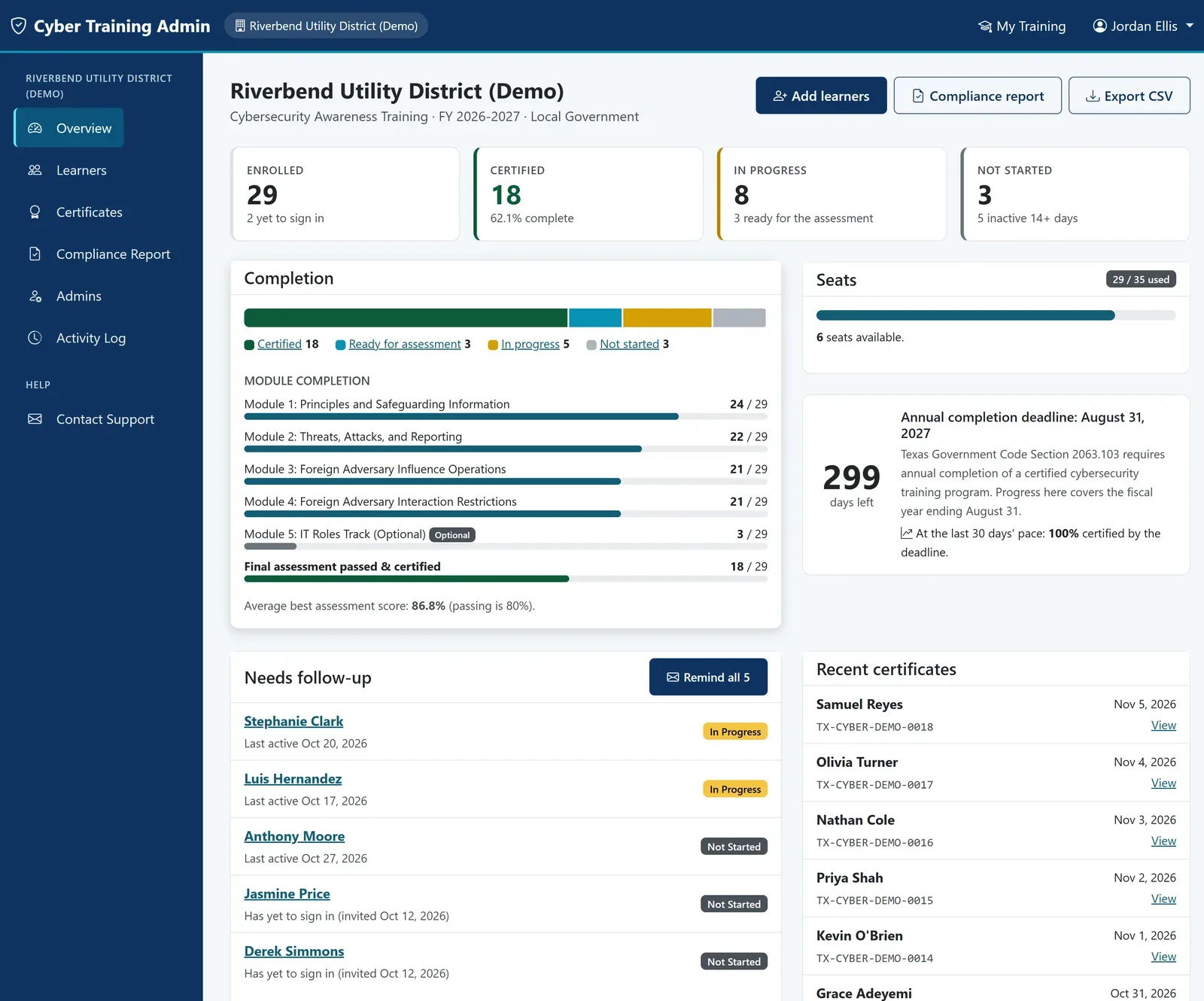
Explore the dashboard your training office would use
Open the real admin portal, loaded with a sample district of 29 staff at every stage of training. Click anything. It's exactly what your institution gets on day one.
- Live completion dashboard with a deadline countdown
- Roster with progress, scores, and one-click reminders
- Every certificate, printable as one PDF
- An audit-ready compliance report in one click
Takes one click. Prefer a tour? Read the illustrated user guide.
Built for large, distributed campuses
Track by college or division
Tag people by college, division, or department, and see completion for each at a glance.
Bulk roster upload
Upload up to 500 people per spreadsheet, with optional department and job title columns.
Shared administration
Invite co-administrators across HR, IT, and compliance, with a full activity log of every action.
Research security
Foreign adversary influence lessons speak directly to research collaborations and international travel.
Audit-ready reporting
Export a compliance report or CSV for internal audit, with certificate numbers anyone can verify.
Accessible by design
Meets WCAG 2.2 guidelines, with video, audio, podcast, slides, and text for every lesson.
Four focused modules, about an hour
- 1Principles and Safeguarding InformationTypes of information, security controls, multi-factor authentication, remote work, and safe use of generative AI.
- 2Threats, Attacks, and ReportingPhishing, quishing, business email compromise, ransomware, and how to report suspicious activity.
- 3Foreign Adversary Influence OperationsHow influence operations target Texas government and where to report them.
- 4Foreign Adversary Interaction RestrictionsThe Section 572.070 rules on gifts and travel and the 30-day reporting requirement.
- +Optional IT Roles TrackCyber hygiene, backups, Traffic Light Protocol, AI attacks, third-party risk, and privileged accounts.
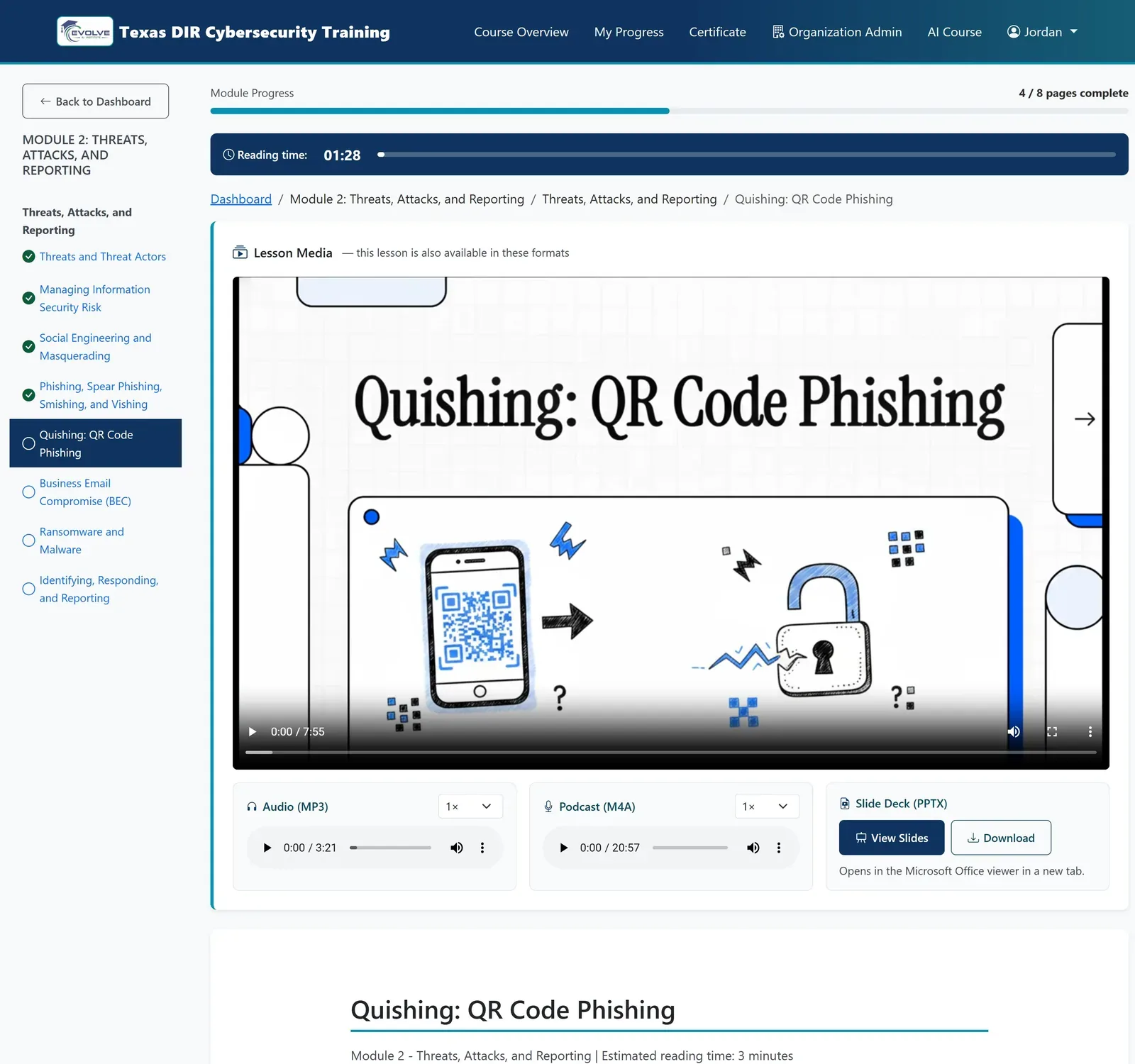
Every lesson offers video, podcast, audio, slides, and text, plus six hands-on practice scenarios.
Up and running in a day
Get your seats
Buy online with a card, or request an invoice against a purchase order.
Receive admin access
Your coordinator gets a link straight into your institution's portal.
Invite your people
Upload a spreadsheet or share a sign-up link. Invitations go out automatically.
Download your proof
Track progress, send reminders, and export certificates and the compliance report.
Per-person pricing with volume savings
Every seat includes the full course, practice scenarios, the certificate, and organization reporting.
More than 500 people, or paying by purchase order? Request a quote or email [email protected].
Higher education: frequently asked questions
Do Texas public universities have to provide cybersecurity training?
Do community colleges fall under the requirement?
Should student workers take the course?
Is this course certified for 2026-2027?
Can we see completion by college or department?
We have more than 500 employees. How does pricing work?
Training for every kind of Texas public entity
Train your whole campus this semester
See the admin portal with real data in one click, then choose the plan that fits your institution.