Cognitive Agency
Who is doing the thinking at each stage?
The student stays the primary thinker, decision-maker, and judge. List the stages and write the thinker beside each one.
Free faculty toolkit · ARAD 2.0
AI-Responsive Assignment Design for Human Learning
New to ARAD 2.0? Read the full framework article for the research, five worked redesigns, and every reference.
Explore the four modes
The human act is the point
AI is excluded because the assignment measures the student's independent cognitive performance.
Say to studentsThis task is done without AI because the reasoning is the skill I am assessing, and I need to see yours.
Downloads
The full editable deck, a print-ready PDF, and the one-page job aid with the seven-question redesign worksheet.
The question behind the framework
Does your assignment still measure what it claims to measure when a student uses AI?
of AI-generated exam submissions went undetected by markers in a blind university study.
+½grade boundary higher than real student work, on average.
About the session
A 60-minute webinar, including Q&A, on ARAD 2.0. You leave with a redesign of one of your own assignments in note form.
What you'll learn
Four modes · mode finder
The four modes have equal standing, and the learning goal decides among them. Answer up to three questions about one assignment.
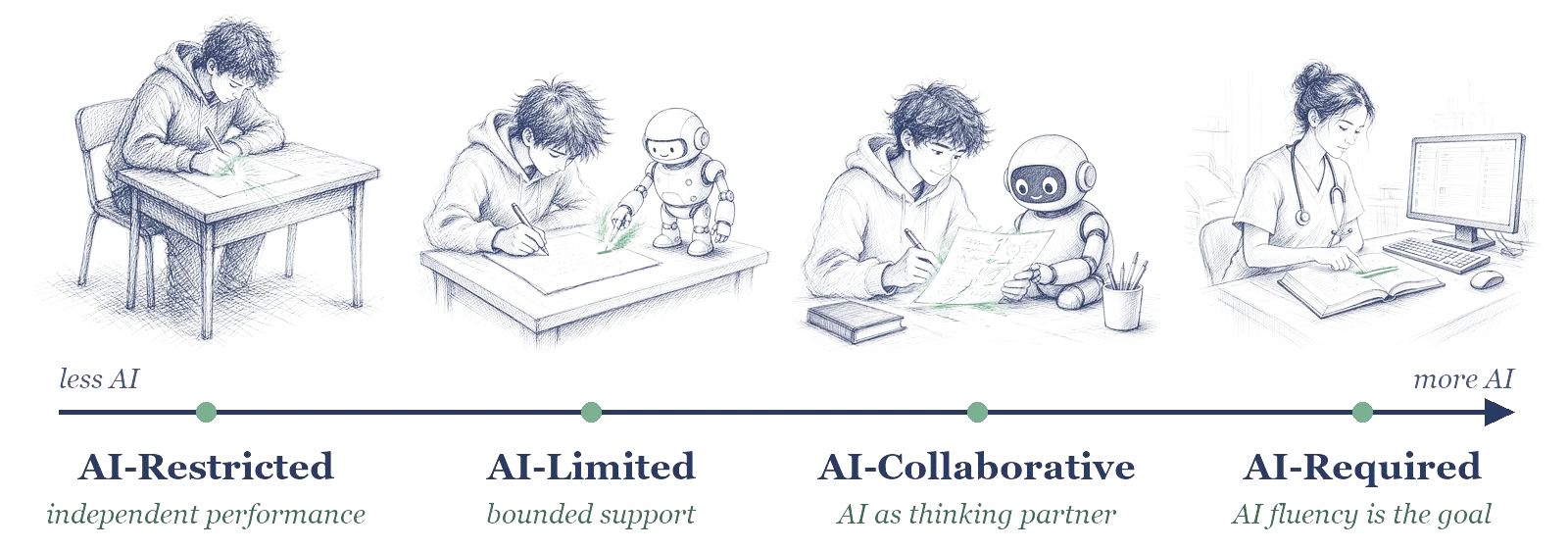
Can students reach the learning target while using AI?
Does AI replace the core thinking the assignment teaches, or support it?
"Replace" means AI could do the exact cognitive work you are trying to build.
Is skilled use of AI itself the learning target, because the field already works this way?
Your mode
Begin with the human learning target for one assignment, then answer the questions on the left.
Always: every major course outcome needs at least one AI-Restricted Transfer Gap Check.
Six principles
Each principle is a design commitment while you build and a quality filter while you check. If an assignment fails any one, redesign that part.
Who is doing the thinking at each stage?
The student stays the primary thinker, decision-maker, and judge. List the stages and write the thinker beside each one.
Does it still measure what it claims if a student uses AI?
Run the assignment through current models and grade the output on your rubric. If it earns an 87, record the 87.
Can I see how the student got there?
Require evidence of how the student thought. One well-chosen artifact, such as a baseline memo or prompt log, usually transforms an assignment.
Must the student judge AI output against course standards?
Verification with teeth: correct at least one AI claim, citing a course reading by page or section.
Has AI removed the difficulty that makes learning stick?
AI may absorb extraneous load like formatting and mechanics. Reasoning, analysis, and synthesis stay with the student.
Can every student do this fairly?
Provide access, teach the tool first, offer an opt-out pathway, and keep AI detection out of grading.
Eight dimensions
Choose the three or four dimensions your learning goal needs. Every Exemplary descriptor demands evidence that is hard to fabricate with AI. Open a dimension to see its anchors.
Performance levels: Beginning → Developing → Proficient → Exemplary
The Transfer Gap Check
Every major course outcome is assessed at least once under AI-Restricted conditions, on the same rubric dimensions as the assisted task. The difference between the two scores is the finding.

Gap of one level or less: the learning transferred, and the student holds the capability independently.
Gap greater than one level: the learning is tool-dependent. Redesign the upstream task toward a more restricted mode, or raise the weight of the restricted checkpoint.
The GOALS process
Once you have done it before, one assignment takes 15 to 30 minutes from target to rubric.
Define the human learning target. What must the student know, do, or judge?
Choose the AI mode with four questions, in order, and share the reason with students.
Design for visible thinking: a formative phase, a summative phase, and one of four patterns.
Align the rubric. A redesigned task graded on the old rubric reverts to the old task.
Scaffold AI literacy, study the results, and re-run the assignment through current models every year.
↺ Annual review sends S back to G.Patterns: AI Sandwich · Verification Challenge · Comparative Analysis · Generative Challenge
Keep going
Bring one of your own assignments, or your sprint notes from the webinar. Both assistants run in ChatGPT.
Read the framework
ARAD 2.0: AI-Responsive Assignment Design for Human LearningThe complete article: theory, four modes, six principles, the rubric, GOALS, five worked redesigns, diagnostics, the programmatic layer, and the full reference list.
Read the full article →